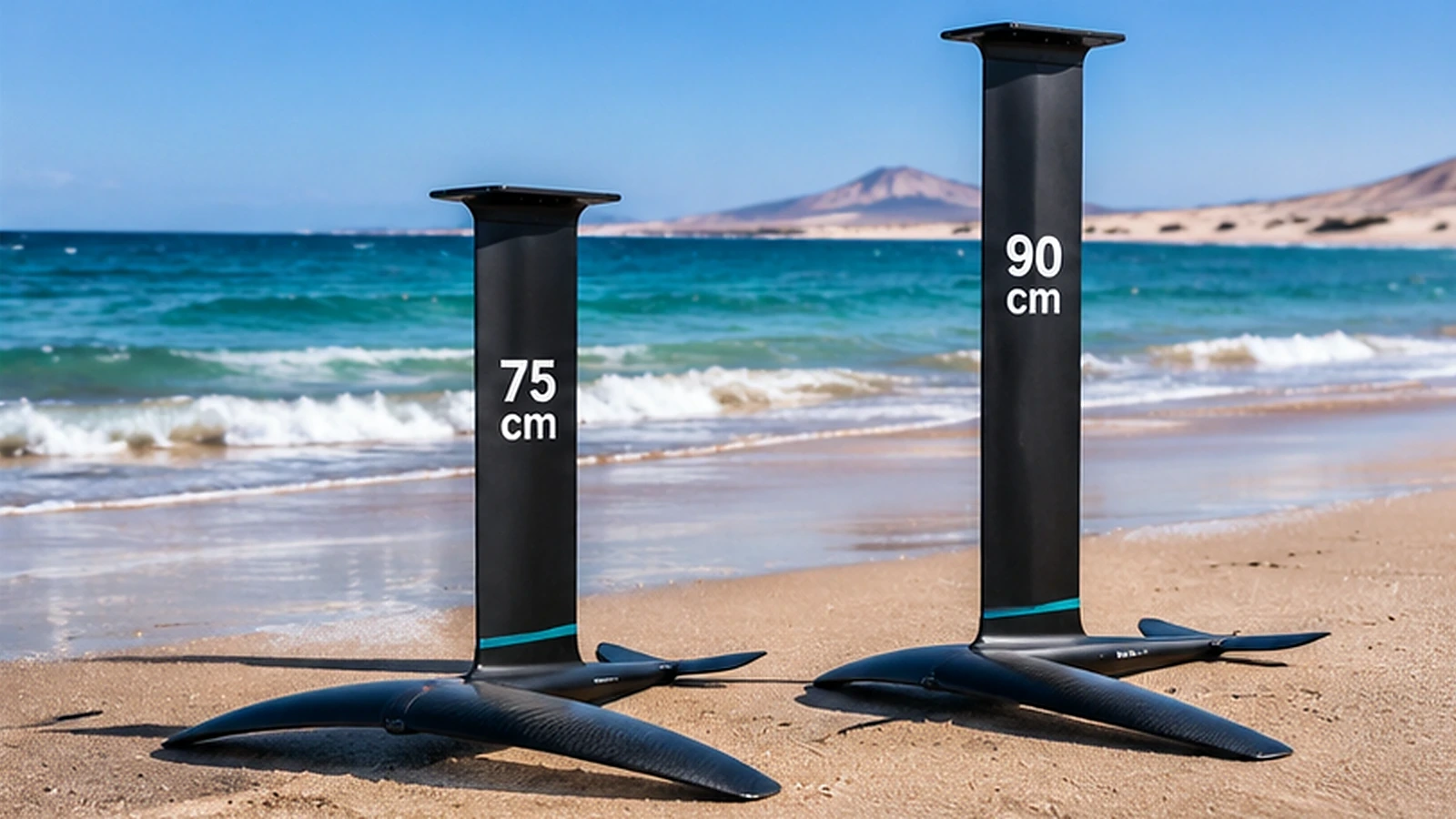
A 75 cm hydrofoil mast generally makes the foil easier to manage in shallower launch areas and keeps the board closer to the water. A 90 cm mast provides roughly 15 cm more vertical separation between board and foil, which can give experienced riders more room to ride through chop before the foil approaches the surface. That extra length also needs more depth beneath you. The better option depends on the water you actually use, not a blanket rule that longer is faster.
What 15 cm of mast length changes
| Practical consideration | 75 cm mast | 90 cm mast |
|---|---|---|
| Water-depth clearance | Less depth is needed than for a 90 cm mast, all else equal | Needs more clearance below the foil |
| Available ride height | Lower working height | More room between board and water |
| Starting and recovering | Often more approachable in suitable learning environments | Can feel more demanding when handling the rig or falling |
| Chop and larger surface variations | Less vertical margin before ventilation or touchdown | More vertical margin when ridden at an appropriate height |
| Transport and handling | Shorter part to pack and carry | Longer part; check bag and travel dimensions |
These are general geometric trade-offs, not guarantees of performance. Front wing size, foil design, board, rider skill, water speed and sea conditions strongly affect the result.
Why the launch spot matters before mast length
Imagine two riders who use the same Ozone foil. The first normally launches from a shallow beach with a long walk to deeper water; the second rides from a sheltered harbour with a deep-water launch. The second may appreciate the additional riding height of a 90 cm mast. The first must prioritise safe water clearance, regardless of the apparent benefit offshore.
Never assume that a lagoon, sandy beach or unfamiliar bay is deep enough simply because it looks calm. Consider tides, submerged obstacles, swimmers and local rules. Carry the board and foil safely to sufficient depth before use, and avoid foiling where you cannot maintain a safe clearance. A shorter mast does not make shallow obstacles harmless.
Launching and depth checks
Before carrying a foil into the water, identify the bottom type, access route and water depth with local guidance. Any hydrofoil can be hazardous near swimmers and shallow obstacles.
Who may prefer a 75 cm mast?
A 75 cm setup can suit riders focused on controlled, lower-height foil practice in conditions with adequate depth. The smaller distance between board and front wing can also make the equipment more manageable when lifting, carrying and arranging a complete setup.
Waterfly lists an Ozone Apex V1 LA1200 kitefoil package with a 75 cm mast. Its listing also identifies the front wing, rear wing, fuselage and shim components. Read the full parts list; choosing the length alone does not establish that the rest of the configuration suits you.
Handling a complete shorter rig
Shorter masts may be easier to transport and manoeuvre at the water edge, but the board, wing and hardware still need safe handling and suitable protective covers.
When does a 90 cm mast make more sense?
With sufficient depth and good foil control, more mast length provides a greater range of possible board heights above a choppy surface. That can help keep the board from touching down as the water level varies. It does not eliminate ventilation or breaches of the front wing; correct height control is still necessary.
For a directly comparable shop example, Waterfly also lists an Apex V1 LA1200 kitefoil configuration with a 90 cm mast. Both listings specify an LA1200 front wing and a 68 cm fuselage, so mast length is a useful difference to examine without switching the entire foil concept. Check each live listing before payment because included components and supply terms may change.
Check that your mast fits the rest of the foil
Mast length is only one item on the compatibility list. Confirm the brand, generation and attachment system for the board-to-mast plate and mast-to-fuselage connection. Check the exact screws and torque instructions in the relevant manufacturer’s manual. Do not assume every carbon foil uses interchangeable parts, even within one brand.
Ozone’s Apex V1 hydrofoil specification describes the construction and the intended kite-foiling application. A complete kit makes it easier to check the component list together than mixing parts based only on dimensions.
A five-question decision checklist
- What is the minimum safe water depth on my route to open water, including tides?
- Do I ride flatter water or repeated chop, and can I control foil height consistently?
- Am I mainly kitefoiling or wingfoiling? Which package is built for that use?
- Will the mast fit my existing board, fuselage and hardware without guesswork?
- What will the complete purchase include, and can I confirm delivery timing?
Compare the available configurations in Waterfly’s hydrofoil packages. If the depth or compatibility answers are uncertain, resolve those before selecting either mast length.